Services / 06 · Reliable build
Development
From approved design to a published system: pages, forms, and integrations, measured and documented.
Start a project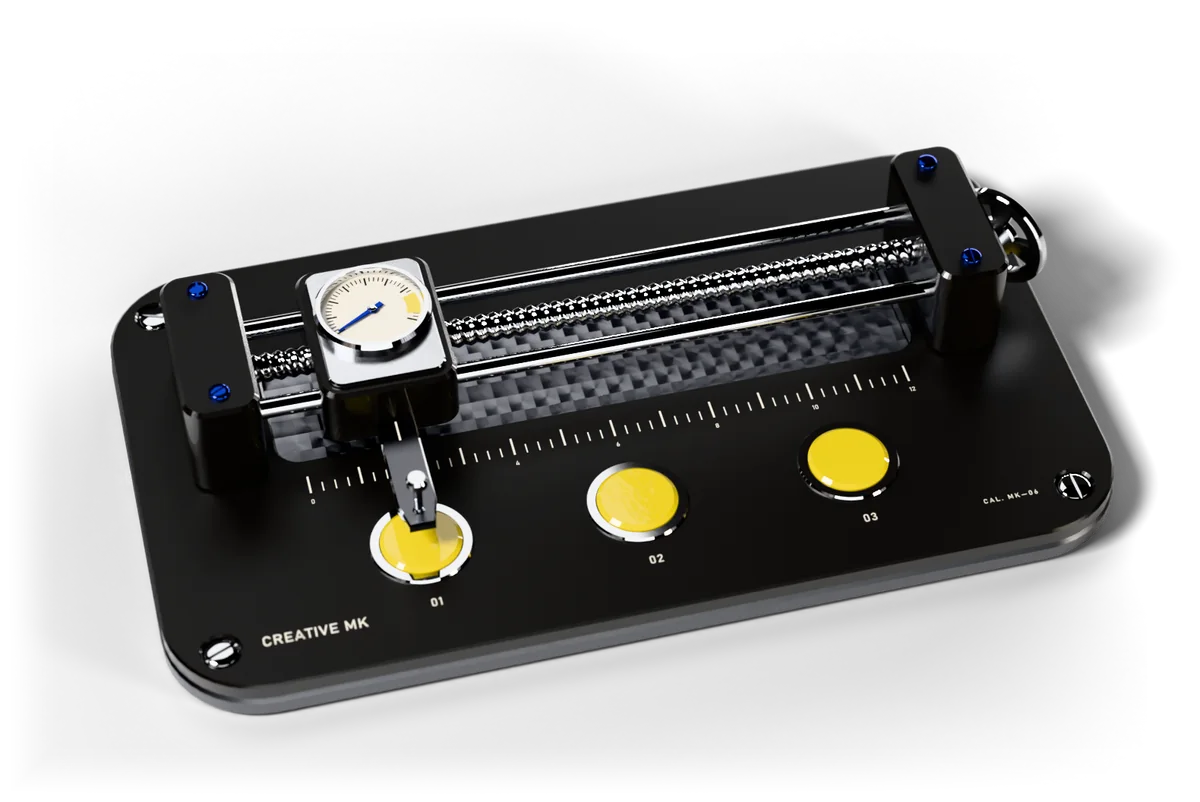
Fig. 06 · Measuring railThe carriage visits three stations; at each one the probe comes down and the needle confirms it is within tolerance.
P. 51 · DevelopmentThe approach
Development is where the project stops being a description.
Strategy decks and design files describe a site; this stage produces the thing itself: pages that load, forms that land somewhere, analytics that record what happened, and integrations that pass a lead to the person who answers it.
The method is the one this site was built with: a versioned repository, a check gate before every deploy, assets fingerprinted so a cache can never serve a stale file, and no script allowed to block first paint. Few moving parts, all of them inspectable. Twice this site broke in public; the commit history names both failures and both fixes.
P. 53
What you get
- 01
Production front end
Responsive pages built from the approved design, with fingerprinted assets and no render-blocking script files — the standard this site itself meets.
- 02
Forms and lead capture
Every form on the property posts to one endpoint and one store, spam-gated, with a tested path to the person who replies.
- 03
Analytics on the conversion path
The events that matter on the way to contact, wired and verified before launch, so the first week produces data instead of anecdotes.
- 04
Integrations
The connections the workflow needs — email notification, CRM handoff, automation triggers — built and tested end to end.
- 05
Deploy pipeline
A versioned repository with a check gate before every publish and a cache strategy that cannot serve a stale build.
- 06
Handover notes
A written map of the system: what runs where, how to change the content, how to deploy, and what to watch.
P. 55
Ways to start
1-2 weeks
Landing page build
One page from approved design to live URL: markup, form, analytics, deploy, and the check that the lead actually arrives.
4-8 weeks
Full site build
The complete front end: every template, form, and integration, plus the deploy pipeline and handover notes.
4-10 weeks
System build
Development that crosses into product or automation: an interface plus the worker, store, and workflow behind it — the shape of the intake agent on this site.
How the work runs
- 01 / 04
Diagnose
We clarify the audience, offer, current bottleneck, and what the first version must prove.
- 02 / 04
Shape
We define messaging, structure, visual direction, UX flow, and the priority service path.
- 03 / 04
Build
We design and develop the assets, pages, automations, or product screens needed for launch.
- 04 / 04
Measure
We connect capture, follow-up, analytics, and iteration so the system can improve after launch.
P. 58
Questions
What stack do you build on?
The smallest one that does the job. This site is a static build served from the edge, with a TypeScript worker behind the forms and the intake agent; that bias — few dependencies, everything versioned, a check before every deploy — carries into client work. If your project genuinely needs a CMS or an existing platform, that surfaces in diagnosis, not after the invoice.
Can you build a design made by another studio?
Yes. Development is sold both as the final stage of a full engagement and as a standalone build of an approved design. The first step is the same either way: we read the design against the real constraints — content, devices, load budget — and tell you what will survive contact with the browser.
What does "ready to use" mean at handover?
Deployed, measured, and documented. The forms are tested through to the store, the analytics events are firing, and you receive the repository with notes on what runs where and how to change it. The test we apply to ourselves: the system runs without us standing next to it.
How do you keep pages fast?
By treating bytes as a budget, not a consequence. Assets are fingerprinted, no script blocks the first paint, and anything decorative has to pay for itself: the 3D field behind this site's homepage replaced 183 KB of engine with 36 KB of renderer, both gzipped. That work is published as a case, measurements included.
Contents
The other five
Let’s talk
Let’stalk
Start with a diagnosis, not a quote. Tell us the bottleneck. If this is not the right service for it, we will say so and point at the one that is.
Start a project
WhatsApp opens with this message already written. You can edit it before sending.